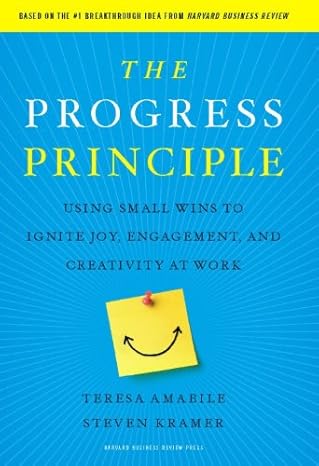
The Progress Principle: Using Small Wins to Ignite Joy, Engagement, and Creativity at Work - By Teresa Amabile & Steven Kramer
Date read: 2026-03-16How strongly I recommend it: 5/10
(See my list of 150+ books, for more.)
Go to the Amazon page for details and reviews.
Blog post turned into a book that centers around 1 case study. Solid advice on how to manage but could have been written in 2 chapters vs. 10.
My Notes
The secret is creating the conditions for great inner work life—the conditions that foster positive emotions, strong internal motivation, and favorable perceptions of colleagues and the work itself. Great inner work life is about the work, not the accoutrements.
It requires giving clear goals, autonomy, help, and resources—what people need to make real progress in their daily work. And it depends on showing respect for ideas and the people who create them.
The secret to amazing performance is empowering talented people to succeed at meaningful work.
Inner work life is the confluence of perceptions, emotions, and motivations that individuals experience as they react to and make sense of the events of their workday.
Inner work life is about perceptions—favorable or unfavorable (and sometimes quite nuanced) impressions about managers, the organization, the team, the work, and even oneself.
Emotions vary along two key dimensions: degree of pleasantness and degree of intensity.5 You can be mildly annoyed by a brief outage of the corporate intranet or enraged by a flippant response to a new idea you floated in a management meeting. Both are unpleasant emotions, but the latter is much more unpleasant and much more intense.
When something happens that grabs your attention at work, you start sensemaking—trying to figure out what it means. Your mind poses a series of questions, especially if what happened was ambiguous or unexpected; these questions and their answers make up your perceptions.
Each of us interprets each workday event against our own backstories in our organizations.
Motivation is a combination of a person’s choice to do some task, desire to expend effort at doing it, and drive to persist with that effort.
Extrinsic motivation drives most of us in our work to some degree—the motivation to do something in order to get something else.
Intrinsic motivation is the love of the work itself—doing the work because it is interesting, enjoyable, satisfying, engaging, or personally challenging.
Relational or altruistic motivation arises from the need to connect with and help other people.
How Inner Work Life Drives Performance
In settings where people must work together to solve challenging problems, high performance has four dimensions: creativity, productivity, commitment, and collegiality.
Creativity—coming up with novel and useful ideas—is probably the most crucial aspect of performance in today’s business world.
Productivity means getting work done on a steady basis, turning out consistently high quality work, and ultimately completing projects successfully. Commitment to the work, the project, the team, and/or the organization is something people demonstrate when they persevere through difficulties, help their coworkers succeed, and do what it takes to get the job done. Collegiality is any action that contributes to team cohesiveness; it is what team members demonstrate when they support each other interpersonally, act as if they are all part of the same team and work effort, and show that they care about how well the team functions.
The more positive a person’s mood on a given day, the more creative thinking he did that day.
We even found a surprising carryover effect showing that creativity follows from positive emotion. The more positive a person’s mood on a given day, the more creative thinking he did the next day—and, to some extent, the day after that—even taking into account his moods on those later days.
If you want to foster great inner work life, focus first on eliminating the obstacles that cause setbacks. Why? Because one setback has more power to sway inner work life than one progress incident.
What matters is whether you perceive your work as contributing value to something or someone who matters (even your team, yourself, or your family).
Four Ways to Negate Meaning:
- Having one’s work or ideas dismissed by leaders or coworkers.
- Losing a sense of ownership in one’s work.
- Make employees doubt that the work they are doing will ever see the light of day.
- People feel that they are overqualified for many of the specific tasks that they are being asked to do.
Micromanaging leaders are quick to affix personal blame when problems arise, rather than guiding subordinates in an open exploration of causes and possible solutions.
The team leaders in our study who got it wrong rarely shared information with team members about their own work.